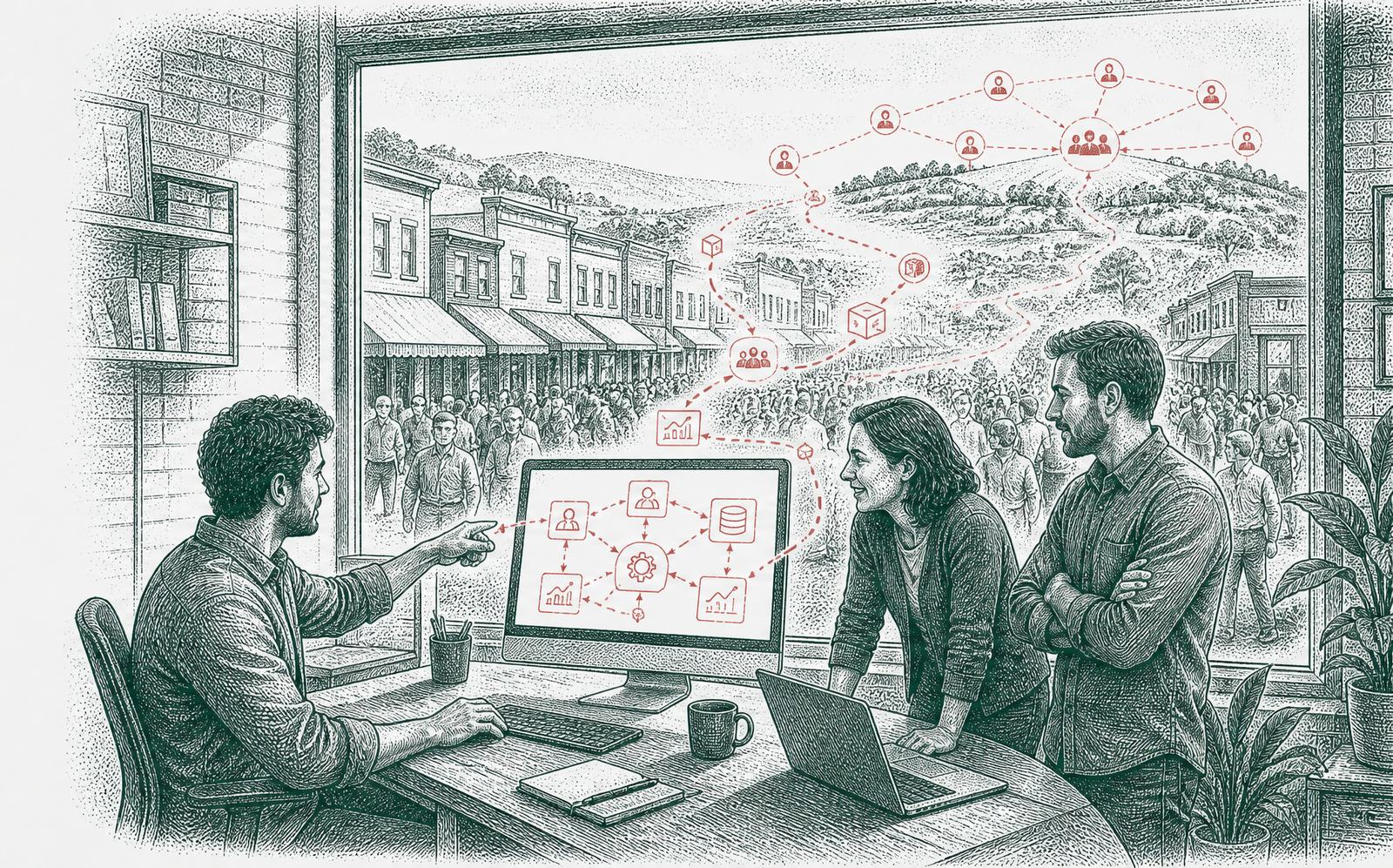
Building capability
Build capability that moves with your ambitions.
You built something substantial. Now the systems that got you here are the ceiling. We build sovereign capability that grows with your business, not off-the-shelf software that makes you operate like everyone else.
You can see the next stage. Your systems can’t carry you there.
You know your industry, your customers and your timing better than anyone. That knowledge is not the problem.
The problem is what carries it: spreadsheets, phone calls, workarounds, and one or two people quietly holding everything together. They kept you flexible while you grew. Now every new opportunity lands on systems that were never designed to carry it, and the business slows exactly where it should be accelerating.
That gap — between what you can see and what your systems can deliver — is where capability building begins.
Efficiency removes friction.
Capability adds strength.
Most technology projects chase efficiency: automating tasks, tidying processes, making the existing way faster. That has value, but it keeps you in the same race. Capability building is different: it lets your business, your people and your customers do something they couldn’t do before. It doesn’t just speed up today’s operation; it creates new options for tomorrow.
What we do
Commercialise
Commercialising Industry Experience
Turn decades of hard-won expertise into a product other people pay for.
Explore →Innovate
Innovating Internal Operations
Remove the friction between departments so work flows across the whole business, not just within a silo.
Explore →
If you need experienced hands inside a build you’re already running, we can help with that too. Enhance Your Team →
How we work
Every engagement follows the same disciplined path. Two things make it transparent and repeatable: Deliver, our adaptive method, and Redprint, the living blueprint everyone works from.
- 1
Map
See how your business actually runs — people, systems, customers, flow.
- 2
Prove
A small first build that delivers a measurable improvement.
- 3
Build with
Your people shape the system, so adoption is designed in.
- 4
Evolve
Release by release, each layer of capability unlocks the next.
Already running on a system you’ve outgrown?
The four moves above assume a fresh build. Most businesses arrive with something else: a system that grew with them and now needs extending, adapting or replacing. Retrospective Redprint is the starting point for that path — it recovers the blueprint and the IP already inside your system, giving you an honest picture of what you own and a clear basis for choosing a direction:
Proof, not promises
Traditional firms sell big transformations, then vanish into plans while nothing changes for months. We start with a proof of value — the smallest build that delivers a measurable improvement — and compound from there. These stories show what that looks like over decades.
Lilydale Books: from 10 schools to 42
A family education retailer served 10 schools for over 30 years. Capability building took them to 42, without growing the permanent team.
Read the story ↓Close ↑
Lilydale Books: from 10 schools to 42
A family education retailer served 10 schools for over 30 years. Capability building took them to 42, without growing the permanent team.
Lilydale Books had served their schools well for more than 30 years, and the way they worked had barely changed: booklists coordinated by hand, every change a chance for error, every new school more load on the same people.
We didn’t start with a grand transformation. The first build simply organised the back office. That proof of value unlocked the next layer: teachers building their own booklists, starting from last year’s rather than from scratch. Then the next: students nominating their subjects and receiving the complete, correct list for their course, parents ordering online. Each release opened the door to the one after it.
Today the platform serves 42 schools every year, and Lilydale staff no longer run the process by hand. Growth stopped meaning more admin. That’s what capability compounding looks like.
News Ltd: seeing profit before the presses ran
When online platforms took the classifieds, one shared picture of every newspaper kept News Ltd profitable on far less revenue.
Read the story ↓Close ↑
News Ltd: seeing profit before the presses ran
When online platforms took the classifieds, one shared picture of every newspaper kept News Ltd profitable on far less revenue.
For decades, classified ads were the rivers of gold that paid for everything. Getting a newspaper out was a daily battle between departments, and nobody knew whether an edition had made money until two or three weeks after it was published. Nobody had needed to: every paper was profitable, the papers still went out, so nothing looked broken.
Then online platforms started taking the classifieds, and that blind spot became a serious problem. We built a digital twin of the newspaper: one place where every department could see each edition taking shape as it was built. The friction and the cost of building the book fell away, and the departments stopped fighting each other.
The same model changed how the business earned. A national sales team could take an election campaign and book it across every edition of every masthead in the country, three weeks out, in a single transaction. Finance could see each edition’s ad volume, revenue and production cost a month before it printed, instead of weeks after, so sales effort went where it was needed while there was still time to act. That single picture is what let News Ltd weather the storm and stay profitable on a much smaller revenue base. The capability then became a product: APS took it to market as Optima, used across Australia and New Zealand.
UtilityVision: from a whiteboard to twenty years of growth
Fifteen contractors dispatched from a whiteboard and plastic folders. Built in stages, the business grew without the office growing with it.
Read the story ↓Close ↑
UtilityVision: from a whiteboard to twenty years of growth
Fifteen contractors dispatched from a whiteboard and plastic folders. Built in stages, the business grew without the office growing with it.
UtilityVision signs off the underground electrical systems for new suburbs. Miss an inspection and a whole commissioning can stall. When we arrived, fifteen contractors were dispatched from a whiteboard, and each job lived in a plastic folder. If the folder went out in a van, that was the only copy. Every new contractor made scheduling harder, not just bigger.
The first build was simply a digital whiteboard. Once the team saw the value, the job details followed, then jobs pushed to technicians’ phones, then a field app with photos, then skills and location matching so the office only handled the exceptions.
Error rates dropped, technicians stayed in the field longer, and the contractor team grew while office headcount held steady. Twenty years on, they’re still a client, and new capability still arrives every year or two.
Tool World: from two owners quoting to every jeweller quoting
Only the two owners could price a ring safely. Captured in software, any retail jeweller can now quote and order in under two minutes.
Read the story ↓Close ↑
Tool World: from two owners quoting to every jeweller quoting
Only the two owners could price a ring safely. Captured in software, any retail jeweller can now quote and order in under two minutes.
Quoting a wholesale ring takes real mathematics on top of metal prices that move every day. At Tool World only the two owners could do it, so growth was capped by two people’s afternoons, and every customer wanted several quotes to compare.
We started with the core: a quoting engine accurate enough that anyone in the office could take a call and quote correctly, and hard enough to get wrong that the key-person risk disappeared. Then we put that same engine in front of their retail customers.
A quote that used to take the better part of an hour now takes under two minutes and doesn’t need the owners at all. Quote volume rose sharply, and Tool World became the easiest wholesaler to deal with. The quote stopped being a bottleneck and became a reason to choose them.
Payrite: an owner’s know-how became a business he could sell
Payrite’s value lived in the owner’s head. Turned into a self-service platform, it let him sell to his staff, and let them grow without hiring.
Read the story ↓Close ↑
Payrite: an owner’s know-how became a business he could sell
Payrite’s value lived in the owner’s head. Turned into a self-service platform, it let him sell to his staff, and let them grow without hiring.
Payrite’s value lived largely in its owner’s head. He wanted to sell the business to his staff, but a business that depends on one person’s knowledge is hard to hand over, and clients still needed payroll right every cycle.
We turned his expertise into a self-service platform. It contacts each client just before a pay run to capture changes, checks what they enter, and gives staff their own view to resolve anything unusual before the final run.
For most clients, payroll became a quick review on their phone. The new owners saved a great deal of time and could grow without hiring, and that capability justified a higher sale price that suited both sides of the deal.
The thinking behind the work
Building Capability is Robin’s book on why some technology builds transform a business and most just add software. Thirty years of builds distilled into a practical guide, with tools you can use straight away — from mapping your business landscape to choosing your first proof of value.
If you want to understand how we think before you talk to us, start here.
Start the conversation
Ready to build capability instead of managing constraints? Book a strategic conversation. We listen to your operational reality, show where capability could strengthen your position, and explore a proof-of-value option that fits. No sales pressure, no obligation.